
“Higher Education Governance Needs to Be Reformed, and Universities’ Role in Decision-Making Must Be Strengthened” - دانشگاه بوعلی سینا همدان
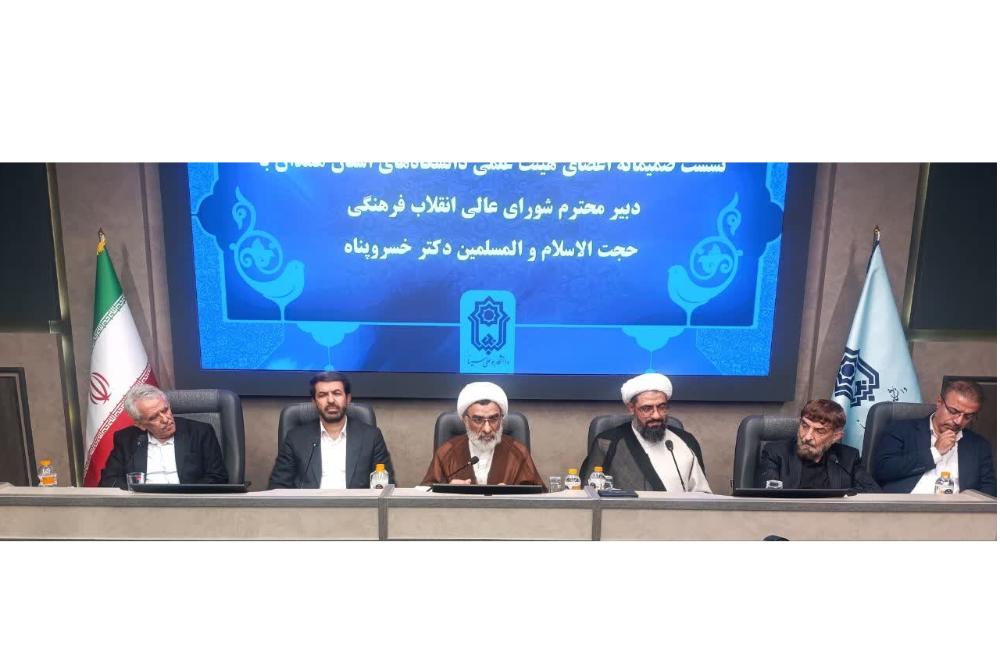
“Higher Education Governance Needs to Be Reformed, and Universities’ Role in Decision-Making Must Be Strengthened”
Secretary of the Supreme Council of the Cultural Revolution Emphasizes the Need to Restructure Higher Education Governance
Hojjat al-Islam and al-Muslimin Abdolhossein Khosropanah, Secretary of the Supreme Council of the Cultural Revolution, speaking at a meeting with faculty members of universities in Hamadan Province, emphasized the role of higher education in strengthening the country’s scientific, industrial, and defense capabilities. He stated that many of the country’s achievements in various fields have resulted from the capacities of universities and the efforts of professors and researchers.
Referring to his previous collaboration with Dr. Mansour Gholami and Dr. Mohammad-Ali Zolfigol, he spoke highly of the two professors and former Ministers of Science, Research and Technology, describing their knowledge, capabilities, integrity, and professional ethics as among their outstanding qualities.
Khosropanah stated that the current model of higher education governance needs to be restructured, emphasizing that this issue is not solely related to wartime or post-war conditions and should be reviewed in accordance with the general policies on science and technology and the country’s higher-level policy documents.
Explaining the role of the Supreme Council of the Cultural Revolution in higher education policymaking, he said that policymaking, regulation, governance, and implementation should be distinguished from one another, and that universities should have greater authority and a more active role at the implementation stage.
Criticizing the excessive concentration of certain powers within the Ministry of Science, he stressed that universities should have greater authority to expand academic fields and educational programs in accordance with scientific, technological, and regional needs, with some of these decisions delegated to university boards of trustees.
As an example of the need to increase university autonomy, Khosropanah referred to quantum engineering, stating that when a university concludes that establishing a new academic field is necessary in response to the country’s scientific and technological needs, it should not have to wait for years to obtain approval through administrative and expert review processes.
The Secretary of the Supreme Council of the Cultural Revolution also highlighted the country’s scientific capacities in emerging fields and emphasized the need for greater attention to artificial intelligence, quantum technology, and cognitive sciences. He noted that some university disciplines and fields of study require revision and that universities should play a more active role in designing and developing new academic programs in line with global scientific developments.
Khosropanah emphasized that universities should play a central role in addressing societal challenges. He stated that issues such as declining social resilience, students’ psychological and social concerns, and other national challenges should be addressed as scientific projects within universities, with practical solutions developed through research.
He also identified university financial governance as another area requiring reform and stressed the need to establish new mechanisms for financing universities and improving the efficiency of resource utilization.
In another part of his remarks, Khosropanah referred to the activities of provincial think tanks, stating that these bodies can gather the views of academics on national science policies and policy documents and convey them to the Supreme Council of the Cultural Revolution.
He called on faculty members of universities in Hamadan Province to specifically examine the role of universities in implementing the documents and policies of the Supreme Council of the Cultural Revolution and, by utilizing the capacity of the provincial think tank, submit their proposals for improving higher education governance.
In conclusion, he emphasized that if a suitable model for higher education governance can be developed through collective academic wisdom, it will be possible to pave the way for significant transformation in this field.